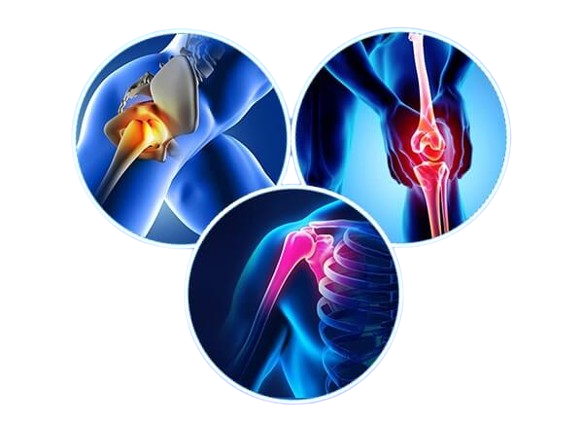

Joint Replacement
Joint replacement is a decision, not simply an operation. Assessment considers the diagnosis, degree of joint damage, effect on daily function and whether non-surgical treatment has had a fair trial.

When pain and stiffness begin to decide your day.
- Pain or stiffness substantially limits walking, stairs, sleep, work or self-care.
- Imaging shows joint damage that matches the symptoms and examination.
- Appropriate non-surgical treatment has not provided enough relief.
- The individual understands the benefits, limitations, risks and rehabilitation commitment.
Replacement options are matched to the joint and diagnosis.
Total knee replacement
Resurfaces the damaged ends of the thigh and shin bones and replaces the joint surfaces.
Partial knee replacement
Treats one affected compartment when the arthritis pattern and ligament function make it appropriate.
Total hip replacement
Replaces the damaged ball and socket with an implant construct chosen for anatomy and clinical needs.
Revision replacement
Reconstructs part or all of a previous implant when a confirmed problem requires further surgery.
Robotic planning supports the surgeon—it does not replace one.
Robotic and navigation systems may support patient-specific planning, implant positioning, alignment and controlled execution. The choice depends on the joint, anatomy, available platform, evidence, cost and surgical assessment.
No technology can guarantee a painless joint, eliminate complications or replace medical optimisation and rehabilitation.
Discuss your concern with Dr. Tarun.
Appointments are available at KIMS Hospitals, Gachibowli and Hale Clinics, Kondapur.